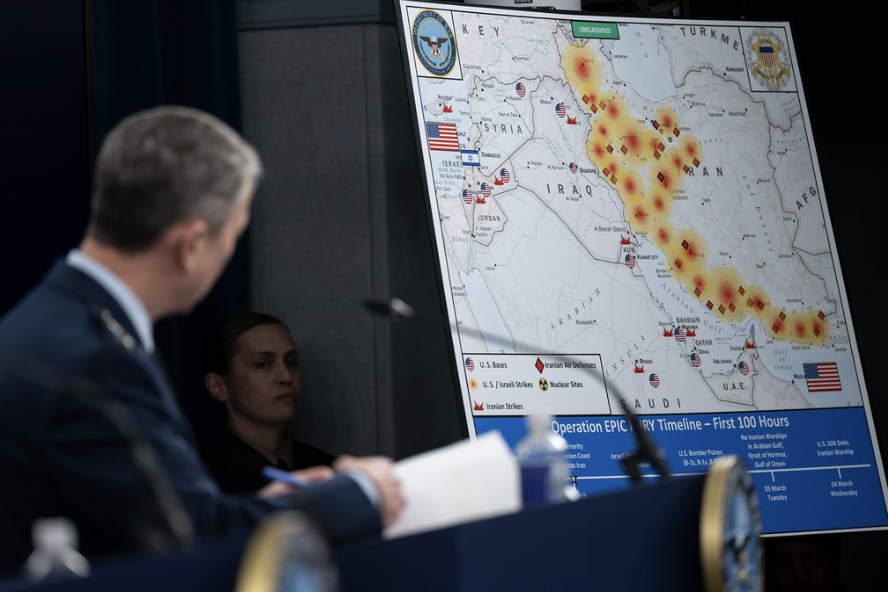
On February 28, 2026 the U.S. launched airstrikes on Iranian military targets in Operation Epic Fury. In coordination with Israel, Iranian nuclear facilities, military infrastructure, and leadership targets were all targeted and destroyed. Over the coming hours after the attacks began around 1:15 a.m. EST, news of these events slowly reached American citizens. Eventually, on late Saturday afternoon, President Donald Trump announced that the strikes killed Iran’s supreme leader Ayatollah Ali Khamenei, which Iranian state media conf irmed later that night.
“The regime’s proxies have continued to launch countless attacks against American forces stationed in the Middle East in recent years, as well as U.S. naval and commercial vessels in international shipping lanes. It’s been mass terror, and we’re not going to put up with it any longer,” Trump said in a comment after the events took place.
In response, Iran began missile and drone attacks on Israel and U.S. allies including the U.A.E., Iraq, Lebanon and many of the Gulf countries. Iran further threatened to attack U.S. allies energy and water infrastructure.
According to NBC news oil prices rose back to above a hundred dollars per barrel causing the president to postpone his threatened escalation over the Strait of Hormuz on Mar. 23. Currently shut down, the Strait of Hormuz is responsible for the passing of 20% of the world’s oil supply. Iran is attempting to fight back by restricting which boats can pass through the Strait of Hormuz. This restriction is currently raising global energy prices and attempts to pressure the U.S. and its allies to back down.
The conflict ensues specifically after failed nuclear negotiations between the U.S. and Iran. The U.S. demanded Iran end uranium enrichment processes (enrichment of the U-235 isotope to a weapons-grade level), limit missile count, and stop supporting proxy groups like Hezbollah, Hamas, or the Houthis.
Shortly after airstrikes on Feb. 28 the U.S. and Israel targeted several major nuclear related facilities. This included damaging entrances and infrastructure to Natanz (a main uranium enrichment site), targeting the Isfahan nuclear complex, and tracking facilities linked to nuclear research.
“Trump, in his brief statement overnight, as in his recent State of the Union address, described the well-known list of the Iranian regime’s misdeeds: its pursuit of nuclear weapons, its extensive ballistic missile program, its support of terrorist proxies, and its brutal suppression of the Iranian people,” Daniel B. Shapiro, former director of the Scowcroft Middle East Security Initiative, said. “What he did not explain is the urgency or the imminent threat that required a war now.”
Right now experts debate over the “imminence” of Iran’s supposed threat. One major criticism is that the U.S. launched the attack while nuclear negotiations with Iran were still ongoing. If this is true it would deeply undermine American diplomacy or destroy trust in future negotiations.
Shortly before the war, Secretary of State Marc Rubio said Iran was “not enriching right now, but they’re trying to get to the point where they ultimately can.”
Senior administrators in the Trump administration clarified that the decision to strike Iran was based on a U.S. assessment of Tehran’s conventional missile capability. It had posed an imminent threat to the U.S. bases and allies in the region. Justification on the claim that the attack was “imminent” relies on mostly classified intelligence.
There is danger in the fact that U.S. allies, for the most part, were caught off guard after the operation. and were not properly consulted. The U.S. still expected support and access to joint military bases in the region.
The confirmed killing of Ali Khamenei meant possibly the biggest blow to the Iranian regime since 1989. The Islamic Republic of Iran is a theocratic state ruled by Shi Islamic law where supreme power rested within its unelected Supreme Leader. There is mandatory religious observance, strict social codes for dress and behavior, restrictions on civil liberties, and inequality for women and minorities.
The killing of Khamenei didn’t collapse the Iranian regime or end centralized control completely, but it crippled Iran’s leadership structure.
“We are now in uncharted territory, and the risk of escalation is extremely high,” Atlantic Council analyst Jonathan Panikoff said.
As Iran maintains pressure on global oil routes and U.S, forces continue to strike, the question today is, what will this conflict ultimately lead to? With rising tensions, all eyes across the globe are in the middle-east.