
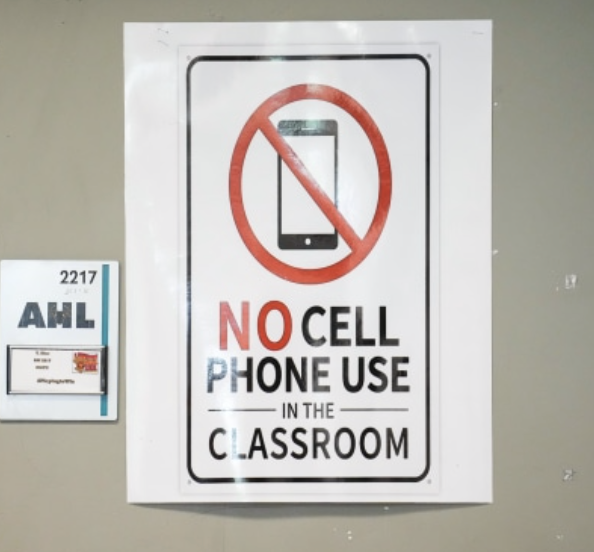
At Ramsey High School on Thursday, Jan. 8, New Jersey Governor Phil Murphy signed a bill into law that prohibits students in grades K-12 from using cell phones and any other “internet-enabled devices” for the duration of the school day. The law is set to go into effect for the 2026-2027 school year, and prior measures to test the effectiveness of a cell phone ban have been tested in schools throughout the state taking part in a phone-free grant program.
Murphy, who is set to leave office on Jan. 20, claims that the cell phone ban aims at limiting student distraction from texts, social media, doomscrolling, and games such as Candy Crush. The guidelines for the cell phone ban are set to be written within the next 90 days in order for the policies to be put into place for the 2026-2027 school year, and Murphy feels hopeful that the cell phone ban will help both students and teachers.
“[In] school districts that have enacted similar cellphone bans, you will often hear the same thing. Students are more focused, they’re less anxious, and they are socializing and laughing with each other, not through a screen, but in the hallways and classrooms,” Murphy said.

The bill also addressed student concerns including procedures for when phone use is allowed, specifically during emergencies, for using translators, and when the school is made aware from a health care professional that a student requires a cell phone. Over at Ramsey High School, a cell phone ban was already put into effect in January of 2025 through the state’s grant program, requiring students to place their phones into Yondr pouches during the day. Although met with some opposition, throughout its duration many students accepted the cell phone ban and have expressed gratitude over it.
“There was no buzzing in pockets. No waiting for the bell just to see who had texted. [It] created a break from nonstop notifications, group chats and the pressure to always be available. The school day felt calmer and more manageable,” Massimo Randazzo, a senior at Ramsey High School, said.
However, many students at NVD have expressed both concerns and anger over the upcoming phone ban. These students feel that the ban is unwarranted, given measures that schools have already taken in recent years, and that the time and energy spent planning the phone ban could better be used elsewhere.
“I was very upset, I immediately thought it was ridiculous and unnecessary. Most classes already have phone holders and don’t let you use your phone during class, so I feel like an official ban is unwarranted and useless,” freshman Daniel Ricci said.
Other students have also shared that they feel concerned about their safety in the event of an emergency, because they would not have their phones to contact anyone. Beyond safety concerns, students are also worried about the loss of important tools that their phones provide.
“Having a phone ban in school would mean that you wouldn’t be able to use your phone for academic related activities such as taking pictures of the board if you have notes on them and want to save them for later or even using Google or the calculator app on your phone,” junior Kristen Liu said. “I also won’t be able to check my classes like I usually do on my phone after every class, and I won’t be able to check the time. So, I’m going to be a little more confused going around school.”
While many students are focusing solely on the negative aspects of the phone ban, others have acknowledged the ambivalence of the phone ban and some positive changes that could occur in the coming school year.
“I think at school we’ll be forced to communicate more with each other, which could bring us closer as a community, but I do think that there will be a lot of pushback against it and people are going to find ways around the phone ban because teenagers are very committed to being on their phones,” junior Meeka Cop said.
Students have also discussed potential alternatives that they would have preferred over a phone ban, including stricter use of phone caddies or holders in classrooms. To Liu, a more individualized approach to cell phone freedom is a better alternative to a complete phone ban.
“I think a better alternative to the outright phone ban is to have a three strike system, like if one student is using their phone for non-academic activities, they could get one strike and then if that keeps on happening, then they could eventually get having their phone banned, but I don’t think that this outright phone ban should apply to all students because not all of us are like that,” Liu said.
The issue also varies between grade levels, as the current juniors have become accustomed to using their phones while at school over the past three years, while the current freshmen have had less time with this freedom.
“As a junior, it’s a little bit frustrating because I’ve been so used to having my phone on me for the past three years. By the time I’m a senior, I’m going to be preparing to go to college in a year and when you think about the freedom we have with technology and the fact that we have less freedom with it now than we did as freshmen, it’s a little bit frustrating,” Cop said.